
When TB Isn’t TB: Why Frontline Teams Must Spot Paragonimiasis Early
A PeerLINC webinar highlights a critical lesson for TB programs: when symptoms persist and the story does not fit, look beyond tuberculosis.
For those of us working in TB control, one hard truth is this: not every chronic cough, episode of hemoptysis, or abnormal chest X-ray is tuberculosis. That challenge was the focus of the May 2026 PeerLINC webinar "When TB Isn’t TB: A Shared Clinical Challenge We Can’t Ignore," led by PeerLINC’s Global Technical Expert Council (G-TEC). In the session, webinar speaker Dr. Vicente Belizario, Jr. called attention to paragonimiasis, a neglected disease that can look very much like pulmonary TB, and can easily be missed if we do not think beyond the usual diagnosis.
Dr. Belizario put the dilemma plainly: the question is not only whether a patient has TB, but whether what looks like TB could be something else. In high-TB burden settings, that distinction matters. Missing the real diagnosis delays the right treatment and keeps patients sick longer.
Paragonimiasis is one of the most important conditions to consider. It is a foodborne parasitic infection caused by lung flukes, and it can present with chronic cough, blood in sputum, and chest findings that closely resemble pulmonary TB. In high-TB burden settings, that makes it easy to miss.
Why Misdiagnosis Matters
The World Health Organization classifies paragonimiasis as a neglected tropical disease. In practice, it is often even more overlooked. For TB services, that matters. When paragonimiasis is missed, patients may be treated as TB cases unnecessarily while the real cause of illness goes untreated.
The cost of misdiagnosis is high. Patients may carry the stigma of TB, endure months or years of unnecessary treatment, and remain unwell despite repeated visits for care. For programs, treating non-TB disease with anti-TB drugs can distort clinical decision-making and expose patients to avoidable harm.
One case shared during the webinar made that risk real. A 49-year-old man from an island province in the Philippines was treated as a TB patient for years because of productive cough and hemoptysis. Even after five years of anti-TB treatment, he did not improve. For frontline teams, the lesson is clear: when the course does not fit, reassess early.
A Number Worth Remembering: 60
Another key message from the webinar: paragonimiasis should not be dismissed as rare or highly localized. Updated mapping suggests transmission may be present in more areas than once believed. For TB teams, that means keeping a broader differential diagnosis—especially when symptoms, exposure history, or treatment response raise questions.
Dr. Belizario also highlighted a striking figure from the slide presentation: 60% of the findings showed co-infection with TB and Paragonimus, and 60% of paragonimiasis cases were misdiagnosed as TB. That is a number worth remembering. It shows that the overlap is not incidental—it is common enough to shape how we assess patients with persistent respiratory symptoms.
For TB clinicians and program implementers, the implication is clear: some patients with confirmed TB may also need evaluation for paragonimiasis. If only TB is treated, patients may continue coughing up blood, remain symptomatic, and be mislabeled as treatment failures. This is why co-infection must stay on the clinical radar—especially when symptoms persist, or the response to treatment does not match expectations.
Once You Find It, Treatment Is Fast
The good news is that paragonimiasis is highly treatable once it is recognized. For TB clinicians and program teams, that makes awareness powerful: a timely diagnosis can quickly change a patient’s path.
Paragonimiasis is usually acquired by eating raw or undercooked freshwater crabs or crayfish carrying the parasite. That makes exposure history essential. Clinicians need to ask about food practices, local terms, and preparation methods—not just symptoms. Once in the body, the parasite can settle in the lungs and closely mimic TB.
Laboratory diagnosis is also improving. Newer methods can detect Paragonimus ova more sensitively and avoid some of the limitations of Ziehl-Neelsen staining, which may destroy the eggs. For diagnostic teams, better awareness and technique can mean faster answers.
The contrast with TB treatment is striking. While TB often requires months of multidrug therapy, paragonimiasis can be treated in a short course. WHO recommends triclabendazole as first-line therapy, while praziquantel is commonly used in the Philippines over three days, with cure rates reported to be close to 100%.
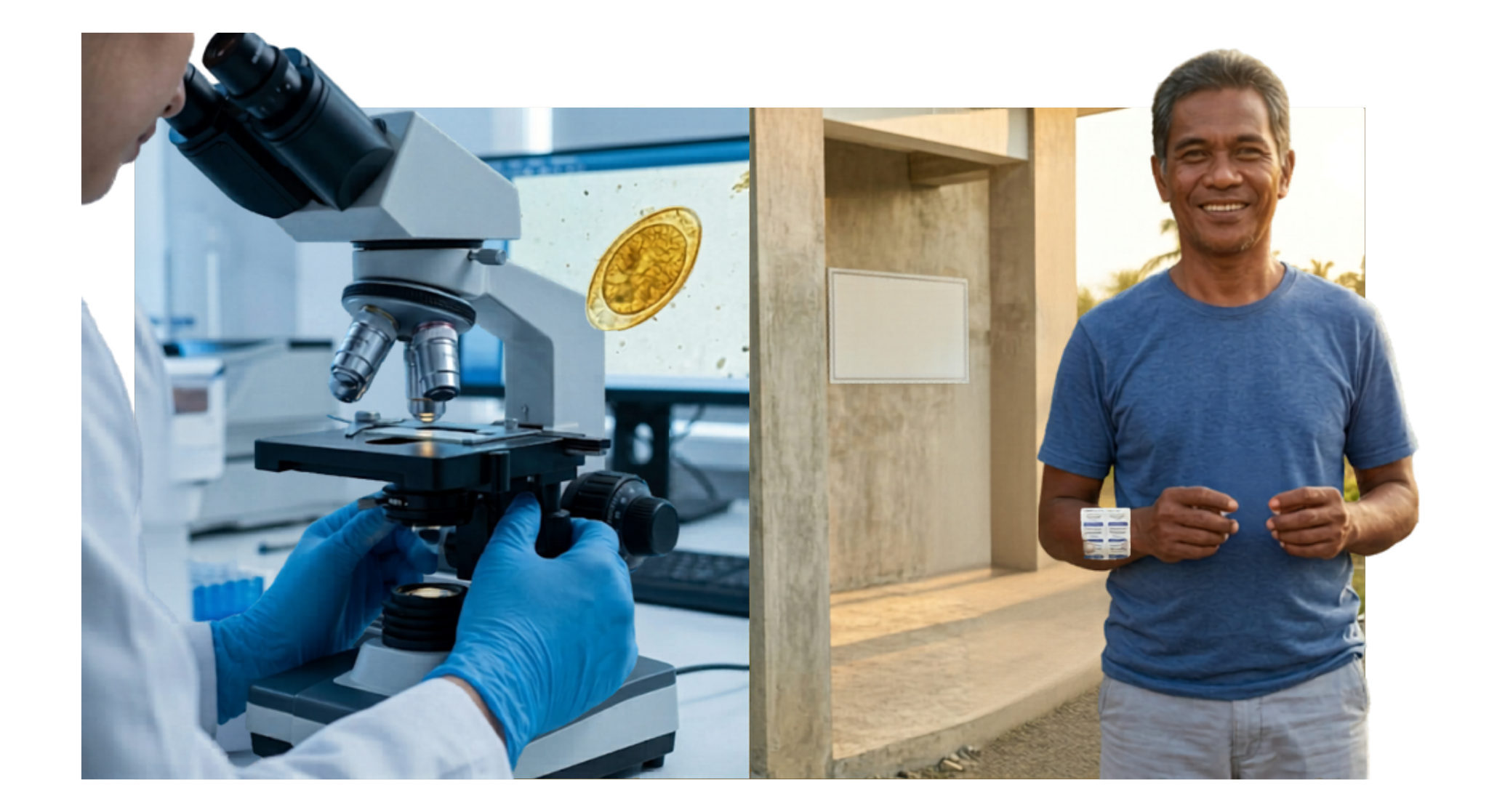
Once detected, paragonimiasis can be cured quickly with medication.
The Way Forward: Integrate, Train, and Educate
For those implementing the national TB program, the message is clear: TB services cannot work in isolation when other diseases can mimic or accompany tuberculosis. As Dr. Belizario emphasized, integrating TB and paragonimiasis control is a practical next step. That means building laboratory capacity, strengthening clinical case management, and expanding health education on food safety, early care-seeking, treatment adherence, and prevention of reinfection.
About the speaker : Dr. Vicente Belizario, Jr. is Adjunct Research Professor, National Institutes of Health, University of the Philippines Manila. A former Dean of the College of Public Health in the same university, he also currently serves the World Health Organization (WHO) as Member, Scientific Working Group, Research Capacity Strengthening, Special Programme for Research and Training in Tropical Diseases (WHO/TDR) and Member, Technical Advisory Group, Reaching the Unreached, WHO Western Pacific Regional Office.
Need expert clinical advice? If you are managing a difficult TB case, especially when a patient is not improving on standard treatment or the diagnosis is uncertain, PeerLINC’s Global Technical Expert Council (G-TEC) can help. Email us for expert guidance so the right questions are asked sooner and the right care begins earlier.